I
have never felt more connected to the Polish community than on that day, as I stood in line to cast my vote alongside numerous others, all sharing the hope of changing the course of our nation’s history and having a say in shaping its future. In some constituencies such as in Wrocław, people were waiting until 3 am to cast their vote. As cringeworthy as it may sound, Polish people on that day truly showed the inspiring beauty of democracy.
While I’m aware that the people queuing with me may not have shared the same political views or voted for the same candidates, I believe that the majority of us had one common thought: “We need to remove PiS from power…” and we did.
However, now that PiS is out of power, what does this mean for Poland’s future? What are the long-term implications, both domestically and internationally, especially concerning Poland’s relationship with the European Union (EU)?
This article will examine those questions with a brief summary of the background of what Poland experienced during the PIS rule and why this election was so consequential for the course of Poland’s history, since the dissolution of communism in 1989.
Poland’s electoral system explained
To truly understand Poland’s election, we need to go back to the basics, which is to explain the electoral system, as there was certain confusion over who won the election, considering that yes, PiS won a majority of seats as a singular party in comparison to other parties.
Poland’s electoral system differs from that of the UK. To simplify the explanation of Poland’s election, I will compare it to the UK’s political and electoral system.
Poland operates as a bicameral democracy, unlike the UK, where only one house’s members are elected by the people. Poland has Sejm (Low Chamber House) and Senate (High Chamber House), similar to the American bicameral system with the House of Representatives and Senate. Therefore, on October 15, citizens of Poland voted for MPs in both chambers.
Senate members, similar to the House of Commons in the UK, are elected using the First Past the Post System—an uncomplicated electoral system where candidates with the most votes win in a given constituency. This same rule applies in Poland.
Voting for Sejm in Poland is akin to the House of Commons in the UK, where the government is formed. But, unlike the straightforward UK system, Sejm members are elected through a more intricate process—party-list proportional representation using the D’Hondt method in multi-seat constituencies. Now, I won’t delve into the complex mathematics behind seat distribution, but if you’re curious, you can explore it further on this page (D’Hondt explained). The D’Hondt unlike the First Past the Post System, often favours the creation of coalitions.
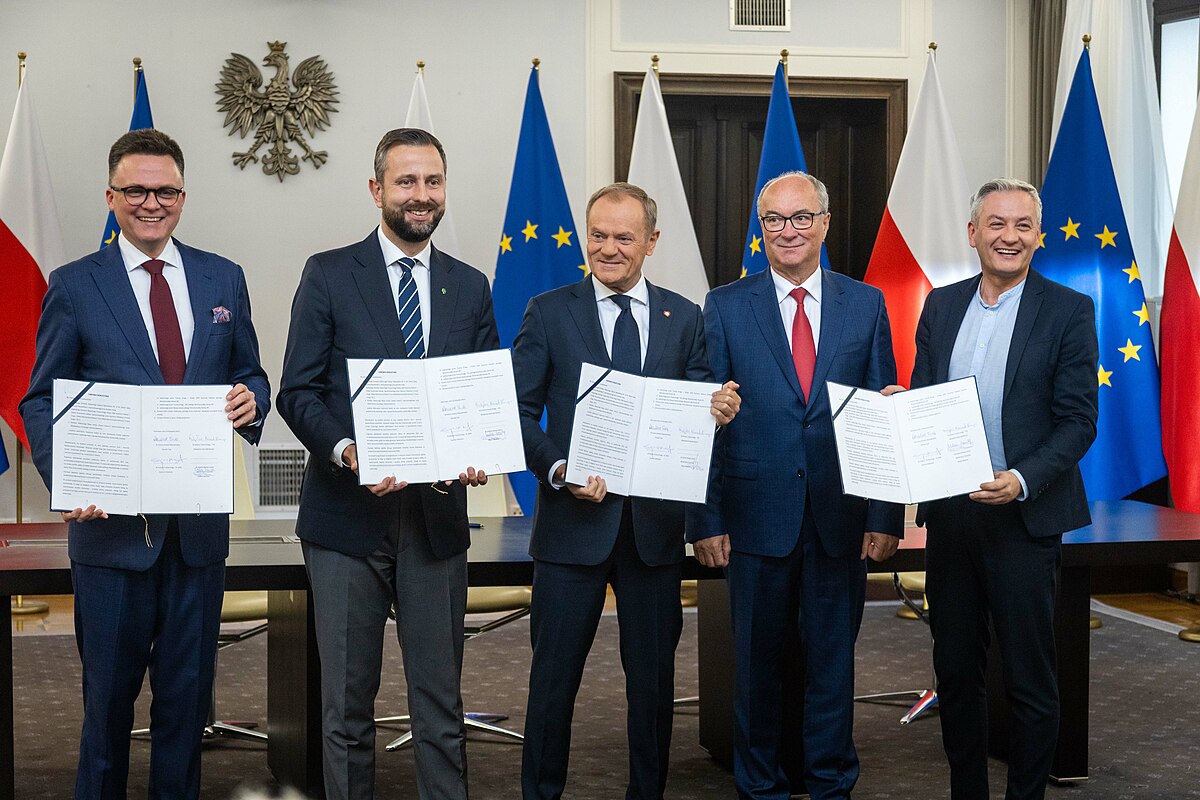
Therefore considering that PiS won the most votes as a singular party, it was in fact, the opposition that won this election. The Civic Platform, Third Way, and the Left agreed to form a government, their combined share of 248 seats constitutes a comfortable majority over a potential coalition that would have to be formed between PiS and another far-right party, Confederation.
Poland Under PiS Rule Since 2015
After the 2015 parliamentary elections, PiS secured a majority, marking the first outright majority since the post-communist era. PiS, a right-wing nationalist party, gained international attention for its controversial and conservative agenda, viewed by many as indicative of a broader trend of ‘authoritarianism’ in the Western world. This victory ushered in growing authoritarianism, a disregard for the rule of law, and conservative Catholic policies impacting reproductive rights and sexual minorities.
My expertise in PiS policies, particularly on reproductive and sexual minorities rights, stems from my master’s dissertation exploring PiS’s macropolitical content. This research, delving into what I termed ‘anti-gender warfare,’ uncovered connections between right-wing populism, anti-gender mobilization, anti-feminist politics, and democratic backsliding.
PiS’s growing authoritarianism can be contextualized through its judicial reforms, which not only intruded on domestic rule of law but also strained the relationship with the EU. In 2015, PiS introduced judicial reforms, including changes to the Constitutional Tribunal (CT). They filled the CT with judges aligned with their agenda, sparking concerns. These reforms led to the EU invoking Article 7, known as the ‘nuclear option,’ resulting in sanctions.
In response, PiS did not reverse the reforms, leading to a daily 1 million Euro fine. PiS, of course, refused to pay, prompting the EU to withhold around 360 million Euros earmarked for socio-economic development (Riegert 2023). This loss has profoundly impacted Poland’s ability to support social and economic progress, diminishing the quality of life for its residents.
The far-reaching consequences
The victory of the opposition coalition signals a return to upholding the rule of law in Poland, and yes, this implies better relations with the EU, including the reversal of Article 7. Poland can finally shed the demoted status of the ‘rogue state’ that it held during PiS governance
Drawing inspiration from Miłosz Wiatrowski Bujacz, I acknowledge that complete objectivity in any written or spoken content is unattainable. Every source carries a degree of subjectivity and reflects the writer’s worldview, especially in political writing. On October 15th, I cast my vote for the Party Together, a new left, social democrat party, and more specifically, for Daria Gosek-Popiołek.
Like Bujacz, I find the Party Together’s promising manifesto could have enhanced Poland’s socio-economic status, emphasizing gender equality, women’s rights, reproductive rights, and LGBTQ+ community rights. Therefore, having the Party Together would have finally brought the necessary changes – reproductive freedoms, LGBTQ rights, and a secular state. Even Civic Platform promised in its manifesto that unveil 100 policies it aims to introduce in its first 100 days in office; one of these policies included ‘abortion up to the 12th week of pregnancy being legal, safe, and available,’ as well as simplifying the gender-recognition process for trans people and introducing same-sex civil partnerships (Tiles 2023).
Regrettably, the Party Together opted not to enter the coalition due to clashes with ignored policies, with a small fraction of the ‘New Left’ entering instead. Having the Party Together could have brought essential changes—reproductive freedoms, LGBTQ rights, and a secular state. This diminishes my excitement for liberal change, crucial given women’s predominant voting share and their prioritization of women’s rights and reproductive health.
Unfortunately, the Third Way in the coalition, which achieved a significant number of seats in the Sejm, has a better negotiating position in contrast to the New Left in this coalition government. It also means that Civic Platform may need to sacrifice some of the policies such as the ‘100 days promise’ in order for Third Way to agree to enter the government. This is particularly exemplified by the newly signed coalition agreement.
The coalition agreement includes a very vague statement on reproductive rights; ‘strengthening rights of women, which is going to be a key matter of action for the coalition, with invalidating the 2020 Constitutional Tribunal Ruling’. Women have a right to decide for themselves.’ Yet, no clear mentions have been made regarding Civic Platform’s promises that 12-week abortion on demand will be legal in Poland or that emergency contraception will also be free and available without a prescription.
All this makes me fear that the only change that this new coalition government will bring regarding reproductive rights is to revert back to 1993 and the so-called ‘compromise’ where legal abortion can be performed only in cases of rape, incest when a pregnancy endangers the life of a woman, as well as in cases of fetal defect. A compromise which, as leading Polish feminist scholar Agnieszka Graff called it, is an inauguration of the right-wing status quo through the imposition of the strictest abortion law in Europe at the expense of women (Graff 2008, p. 158). I also do not believe any significant changes will be made in regard to the rights of sexual minorities.
In fact, MP for Third Way Władysław Kosniak Kamysz is against abortion and stated that ‘‘worldview’’ matters cannot be elements in a coalition contract,’ and by ‘worldview’ matters, which is a Polish way of saying liberal, including reproductive and LGBTQ rights are out of the question. The leading MP and former entertainment broadcaster Szymon Hołownia, in fact, decided that the best way to deal with the abortion issue in Poland is to have a referendum.
Faded enthusiasm- final thoughts
While I am relieved that PiS is no longer in the governing position, my enthusiasm remains tempered by the news that the Party Together has chosen not to enter the government. The primary reason for their decision is their unwillingness to align with a government that does not endorse crucial policies vital for Poland, including legal and safe reproductive health, secularization, and the legalization of LGBTQ partnerships.
Despite the new government marks the end of the Cold War between Poland and the EU, fostering improved relations with Europe, and isolating the right-wing government in Hungary by Victor Orban, I harbour scepticism regarding the substantial domestic change in Poland.
In anticipation of potential criticism, some may question the relevance of reproductive rights to economic policies, such as the ‘tax threshold’ that the coalition will introduce, and argue that, once in power, Poland can finally receive full EU funds without fees, thus domestically rule of law in Poland and by this liberal democracy will be safe in Poland. However, I contend that a liberal stance on reproductive freedom is integral not only to enhancing the quality of women’s lives but also to boosting economic productivity and resilience, both at the individual and national levels. Reproductive freedoms contribute to increased labor force participation, thereby fostering greater economic development for the country.
Beyond the economic advantages, securing reproductive freedoms becomes pivotal for upholding a fully functional liberal democracy. It serves as the paramount embodiment of the separation between church and state, indicating a profound respect for every facet of human rights. Disregarding reproductive rights in the analysis of democratic backsliding epitomizes a ‘malestream ‘-dominated theoretical approach. Similarly, overlooking the rights of the LGBTQ community neglects a substantial segment of Polish society, disregarding their mental and physical well-being. Recognizing and accounting for their rights not only ensures their inclusion but also correlates positively with Poland’s socioeconomic standing, and yes it would be also a sign of a functioning liberal democracy.
For Poland to truly thrive, it must become a secular nation, prioritizing the needs of women. Women should no longer be viewed as passive participants in the country; rather, they are the essence of the nation, as evidenced by their instrumental role in preventing PiS from returning to power. Women consisted majority of 2023 voters and were the strongest group voting for opposition than men. This coalition owes them legal and safe reproductive freedoms. However, there is a lingering doubt that these promises were merely empty words. Will I be proven wrong? I certainly hope so.

Hi, I’m Dominika, the sole author of this article. I created this space to connect my ideas and express my political and social commentary in the vast digital void. Here, my consciousness speaks through.