A
s promised I am delivering the second part of the post on gendered economic inequality. To understand the theory of gender and its incorporation into the mode of inquiry in economics, I highly recommend reading the first post.
To recap, the current economic system had effectively established binary realities. The binary division of ‘private’ and ‘public’ with the former being the ‘feminine’ (subordinate) and the latter being ‘masculine’ (superior). The realities of this division and its subsequent implications are so much more complex and deeper than simply reducing women to subordinate positions on the career ladder.
Such binary imposition also resulted in reducing the emotional, care-related jobs to the private sphere- which had been dubbed by traditional economics as a ‘non-monetary’ sector of the national economies. Ultimately, the treatment of this ‘private sphere’ ricochets on the public spheres of industries such as teaching, nursing, and other works that are tied with care, emotional support, and thus with ‘femineity.’
I mean is it a coincidence that jobs such as teaching and nursing, both professions whose work revolves around care and emotional support are severely underfunded by the governments?
In the UK alone, nursing is indicated in the top ten occupations with the highest density of female employees, alongside other-care-work sectors such as teaching (RCN 2021).
Nursing, despite being a labor-intensive job as particularly confirmed by the recent pandemic health crisis from COVID-19, is severely underpaid. Accordingly, the ‘pay for nurses and other National Health Service (NHS) staff in England will have fallen in real terms by more than 7% since 2010’ (Helm 2021). The other top 10 professions which have ‘the highest density of women, the average earnings range from £330 to £629’ (per calendar week/ month) in contrast to average earnings between £407 to £830 in the top 10 professions ‘with the highest density of men’ (RCN 2021).
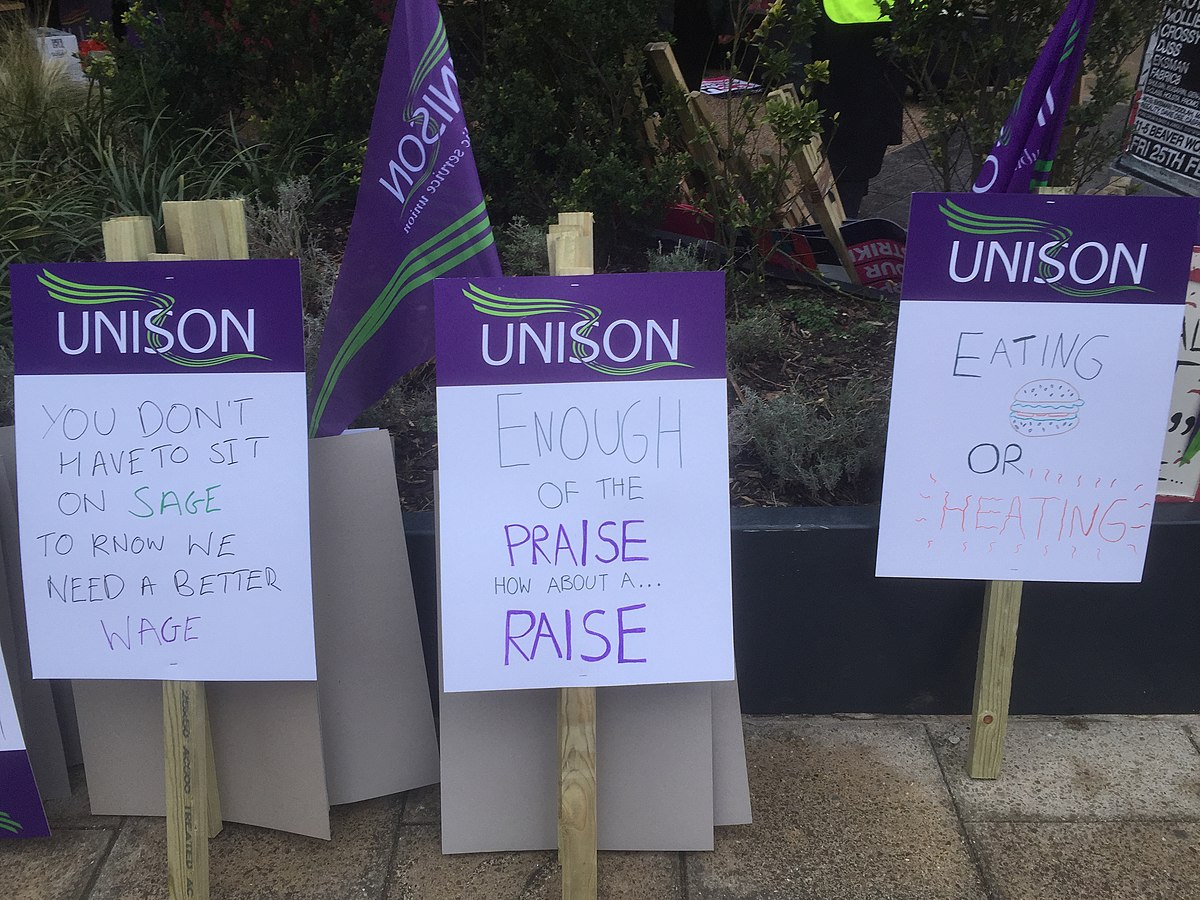
The current UK government’s position on NHS workers is more than obvious to the UK public. The UK continues to be paralysed by the NHS strikes and for good reason. The UK government offered a pay rise to nurses, with less than 5% above inflation.
The NHS as a sector itself had been austerity’s primary target for decades, and even though in 2018 £20 billion investment was made, it is still not enough, after years of sustained and systematic underfunding is not enough. The pandemic itself provided a traumatic experience for the morale of the staff, yet the challenges for the NHS will not cease, with the demographic changes that the increasingly aging population poses (NHS Support Federation).
According to the data, former prime minister David Cameron’s decision to reduce the NHS annual budget from 3.6% to 1.5% had been pinned as a key source for the NHS’ loss of capacity, and prolonging the waiting time targets (The Guardian 2022).
If yet gender has nothing to do with the treatment of this particular sector of the economy, let’s contrast the way in which the more ‘masculine’ perceived sector of the economy is treated in the UK: finance. According to the data, pay, and bonuses for those who worked in the finance and insurance sector had increased by an average of 6% since 2008, compared with a rise of less than 2% for nurses, midwives, and paramedics (The Guardian 2023).
Therefore, it seems semi-ironic that in 2008 both sectors’ experiences when it comes to their pay and funding were drastically different. While the NHS-necessary organ in a country for society’s survival became a prime target of neoliberal austerity, the more ‘masculine’ finance industry was booming with economic opportunities and benefits. Taking gender into account of this, the reasoning behind such actions is becoming more frustrating, and its consequences are both horrendous and unjust, with the paralyzing effect this may have on the betterment of society as a whole.
The national strikes experienced in the UK indicate the private is, in fact, political despite the claims otherwise. Through institutionalisation of care work being done for free by women and girls, impacted and continues to influence the way the government’s perception of the importance of its work as irrelevant for an economic boost when contrasting with a more masculine profession such as finance.
Teaching in the UK is also classified as a profession primarily with the highest density of female employees, and unsurprising therefore is also a sector where its employees are not perceived as worthy of better economic compensation as in October 2022, the Department of Education only offered a 3.5% pay rise.
‘It’s not shocking for me that the UK also faces a major pension gap between women and men. If professions that have a higher number of female workers are also sectors of the economy where the pay does not even reflect the high living cost’
Unsurprisingly, the data collected by the Ministry of Education indicated that 40,000 which is almost 9% of the workforce left state schools before retirement in 2021-2022. To add on, the data also showed that unfilled teaching vacancies were at a record high with more than 23000 empty positions in contrast with 530 decades earlier (The Guardian 2023)
The comprehensive schooling system just like the NHS itself is also extremely underfunded, with recent reports indicating that with the increased inflation and energy prices, and shortage of teachers, the schools will simply run out of money (The Guardian 2022). These current circumstances are contributing factors that impact the quality of teaching, thus further entrenching the uneven field of education between private and public school pupils.
It’s not shocking for me that the UK also faces a major pension gap between women and men. If professions that have a higher number of female workers are also sectors of the economy where the pay does not even reflect the high living cost, not to mention the actual economic value that their job is worth.
The UK is not the only country where the above emotional-care sectors are underfunded, and their employees are being underpaid. A similar trend appears to be standard in most other developed countries. The data indicated that many governments even after the experience of the deadly pandemic failed to increase their spending on social services, including health, social protection, and education. The 2022 Commitment to Reducing Inequality Index showed that 81% of the population lives in countries, where the governments cut the spending on health services (Oxfam 2022).
Those living in the UK are already experiencing the paralysing effect the systematic underfunding public sector may have on them. Many patients are often treated in the back of ambulances or in corridors, waiting rooms, and even cupboards, or sometimes not at all. In December 2022, 54,000 people in England had to wait more than 12 hours for an emergency admission and ambulance wait time exceeded 90 minutes. While millions wait more than 2 weeks for a GP appointment which in some cases could be extremely dangerous, in particular for those experiencing cancer symptoms. The consequences of this underfunding had been even recorded with 20% more excess mortality in the week ending December 30 than in the past 5-year average (CNN 2023).
The connection between gender and the contemporary crises of public sectors, especially in the UK which had witnessed a national strike of various public industries seems to indicate that gender is not only an ‘alternative’ viewpoint of the world but also an essential viewpoint that needs to be taken into account, especially in the policymaking.
The bias created by the binary worldview is not just unjust but also incredibly harmful. The long-term consequences of undermining such public services will have a long-term negative effect by furthering socio-economic inequalities in Britain, and around the world. The entrenched cycle of poverty is a significant consequence of these actions, but the other issue that will stem from it will accelerate polarisation and antagonism within societies, through increased crime, racial and gender inequalities, and deteriorating physical and mental well-being that will particularly affect the most vulnerable communities.

Hi, I’m Dominika, the sole author of this article. I created this space to connect my ideas and express my political and social commentary in the vast digital void. Here, my consciousness speaks through.