
M
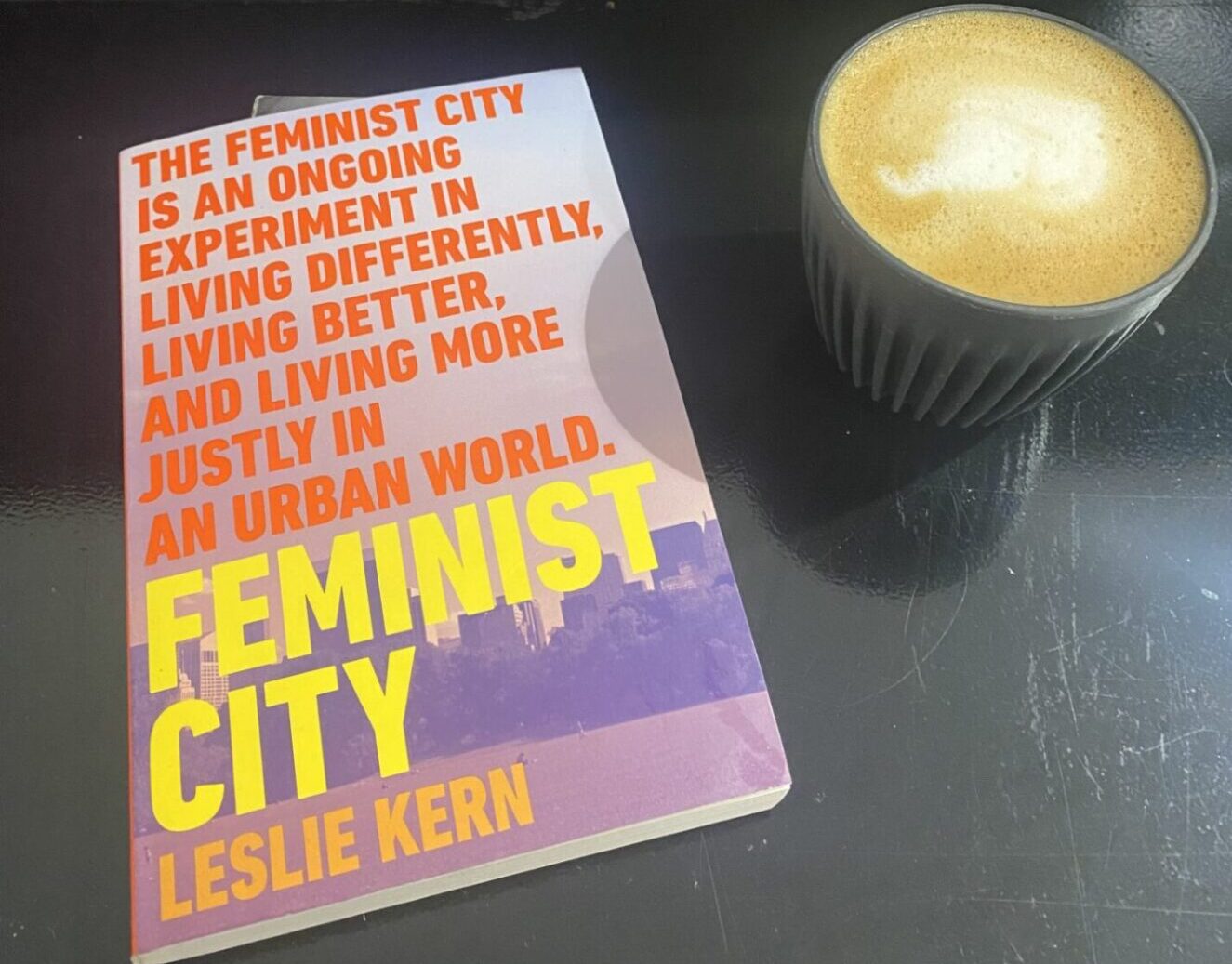
y last month of summer was spent immersed in the pages of ‘Feminist City’ by Leslie Kern. I had taken up the summer reading challenge organized by MuzeumHerstory, a Polish nonprofit organization and civic initiative dedicated to women’s arts and histories. Among the suggested readings, was ‘Feminist City’ by Kern, a book which had been on my wish list for a while, making it an obvious choice.
Just a month before that, I had finished reading a book that had long held the top spot on my reading list – ‘Invisible Women’ by Caroline Perez. The prospect of delving into the subject of public spaces and how they often neglect the needs of women was exciting to me. Both of these books, though distinct in their approach, shed light on urban planning and city infrastructure. They share a common goal: challenging the current city structure that revolves around heteronormative and male-breadwinner standards of living, priorities, and desires.
Perez’s book is engrained in empirical research, earning her the well-earned label of the ‘Beauvoir with data.’ On the other hand, Kern takes a more storytelling approach, incorporating her own experiences as a young woman and later as a mother, examining how these changes interact with the city and how the city, in turn, shapes her as her body and mind evolve. In many ways, Kern’s book reads like a love letter to the cities she has called home. However, this love is far from blind obedience; it’s a love that questions and critiques. As much as she adores city living (as I do myself), Kern keenly observes the inherent flaws that make cities both realms of freedom for women and marginalized communities and, simultaneously, places of fear and abuse in all its forms.
And so, as I reflect on these enlightening reads, my thoughts unfold.
The post will be split into two separate posts. This post will focus on the urban design of cities and public transport and how it affects gender equality and equity, the second part will focus in more depth on safety, and current developments and trends in planning the future of inclusive urban spaces.
A city designed for male breadwinner- retreat to suburbs
As I write this post, my thoughts flow freely as I sit in a local café in the suburban area where I currently reside. It makes me realize that this is how exactly cities are built, together with gentrification (a topic that I mention in the second part of this post) this is the present reality of city infrastructure and urban planning.
You know the American Dream, right? The white house in a peaceful suburban neighborhood with lush greenery, a picket fence, children riding their bikes, and a husband with a BMW or Volvo parked outside, making his way to his sanctuary after 8 hours of work, where his wife has prepared delicious dinner and helped their kids with homework. It’s almost like Odysseus returning to Itaaca, to his faithful wife; Penelope. Of course, minus the dramatic features of 10 years of separation, killings, Trojan wars, and sea living creatures trying to kill him. The contemporary return of Odysseus is more now home in the suburbs with a wife- poetic, static reality of his retreat from work, and drama involving ‘Jeff from Human Resources.’
Well, the more I think about this 1950-1970s ‘American dream’ the more I realise more or less majority of cities are designed like that. Cities often exhibit a binary divide (yes, ‘binary’ is perhaps the most frequently used word on this blog). As a corporate worker, in an industry that has been male-dominated for years, I leave my house by bus (which is not the most popular mode of transport in my area, and definitely not the most male-used mode of transport) to commute to work. After eight hours on the job (not counting the 30-50 minutes commute), I retreat to my flat in a suburban area, my private sanctuary.
As mentioned, a private sanctuary for the majority of men is a place of relaxation, but for many women, especially those with children, and those who are married or in heteronormative relationships/cohabitation arrangements is not so much a sanctuary but also a place of work, and this straightforward and linear journey from work-home home-work is not as applicable for the majority of these women.
Both Kern and Perez make the argument that cities had been designed around the male breadwinner concept, and how this planning had resulted in a flawed public transport system. Kern and Perez argue that cities have been designed with a focus on the traditional male breadwinner concept. Kern, in the initial 33 pages of her book, emphasizes that cities fail to address this issue posed by suburbs, which perpetuate patriarchal and heteronormative gender roles (Kern 2019)
This is because in many countries, city planners legally plan layout cities through something called ‘zoning’ which in simple terms means that ‘cities are quite literally divided into commercial, residential, and industrial single-use areas.’ This zoning link back to antiquity, and it of course does not reflect many women’s life (Perez 2017, pp.39-40)
As a resident of Manchester, I can attest to the visibility of this separation between home and work, as Kern and Perez suggest. Kern quotes geographer Kim England, who asserts that this gendered binary vision is “fossilised in the physical structure of our cities. This includes the placement of residential areas, workplaces, transportation networks, and the overall layout of cities, all of which reflect the expectations of a patriarchal capitalist society regarding where, when, and by whom specific activities should occur.” (Kern 2019 p. 33).
Kern and Perez also draw attention to how this male breadwinner vision affects the design of public transit systems that fail to meet the needs of women and other vulnerable demographics. Thus urban planning has its own predetermined culture dictated by the male hegmonic paradigm.
The neglect of public transport
For numerous working-class women, me included, owning a car is ridiculously expensive and often not a viable option. Consequently, relying on limited or underinvested public transport, especially buses, can be an exhausting experience. It can also significantly complicate the journey from home to work and back, particularly for women with childcare and elderly care responsibilities.
As a former Londoner, I can’t complain about the public transport system. During my teenage years, I took two London buses to get from home to sixth form, and surprisingly, I didn’t mind it at all. Why? Well, it was free, and it offered me some cherished “me” time during which I could read a book or listen to music. Moreover, I rarely had to wait long for a bus, and if I did, I had the alternative of taking the tube.
Admittedly, there were safety concerns, and I encountered unwanted attention and harassment from random men on public transport. However, I consider myself fortunate, given my overall experience. Perhaps the one thing I miss most about London, aside from its imperfect yet well-expanded public transport system, is its advanced public transportation, which remains superior to what we have here in the North. As a young professional woman, the use of public buses is no longer the blessing it once was.
Data is here ‘women are invariably more likely than men to walk and take public transport ’and ‘men around the world are more likely to drive’ (Perez p.29). Perez highlights this in the chapter ‘Can Snow Clearing Be Sexist.’ The bus is the most feminised form of transport. Since the book was written in 2017, I decided to confirm this argument further by having more recent data. Accordingly in the UK, women take an average of 56 local bus journeys per year, while men take an average of 43- this is a 30% difference (Jiang 2022). In fact a similar pattern of gendered transportation is emulated in Europe. (European Parliament 2021).
Returning to the point, the journey of many women who have caregiving responsibilities often involves dropping children off at school or picking them up, transporting the elderly to doctor’s appointments, and perhaps squeezing in some grocery shopping on the way back from work. Imagine lugging a trolley loaded with groceries down pavements that haven’t seen refurbishment since the 1960s, only to board a late or overcrowded bus?
Of course, public transport can be quite a neglected matter, especially in areas outside of London or in rural areas. This neglect further exacerbates inequality, ostracizing vulnerable and low-socioeconomic demographics from effective social mobility.
Perez highlighted in her book that 2014, bus fares had increased since 2014 as collateral damage to the neoliberal cuts to public services. This of course changed just recently in 2022 as a response to the rising cost of living. The £2 fare cap had been introduced across the UK and has been extended until October 2023.
The same fare plans had been upheld by Manchester city major Andy Burnham who also plans to integrate bus, tram, and bike transport under the unified Greater Manchester control as modeled on Transport for London. This integrated system, known as the Bees Network, will come into effect on the 24th of September.
While this policy shift is expected to make life easier for vulnerable demographics, it’s also been lauded as a ‘revolutionary’ move by many commentators. To me, as someone from Poland, and who lived her teenage years in London this unified transport system was a standard feature of my commute, not to mention it was a logical approach to managing urban transportation, instead of having different companies running this. This is because, it means buying separate tickets, thus extra economic costs are undertaken by those who are already economically vulnerable.
The privatization of public transport, driven by Thatcher’s broader neoliberal agenda, took effect in 1985 with the passage of the Transport Act 1985. This move contradicts the Public Equality Law passed in 2011. Until now, individuals from low socioeconomic backgrounds have not only had to contend with inadequate bus transportation but also the financial burden associated with it, and it seems that the state has been operating on an illegal basis since (Perez 2017).
The cost of fares and privatization is not the sole issue afflicting urban bus systems. The LGA has highlighted that due to the pandemic, bus operators experienced a significant 15% decline in passengers. To mitigate the increasing costs, primarily driven by rising fuel prices, operators opted to discontinue certain bus routes (The LGA 2023)
According to the Traffic Commissioners for Great Britain, registrations decreased from 10,941 in 2022 to 8,781 in 2023, indicating a reduction of 2,160 routes (BBC 2023). Consequently, this leaves an estimated 85% of individuals who still rely on these routes without any transportation options. As a result, Jonathan Bray, the Director of the Urban Transport Group, has labelled the £2 government scheme a ‘mockery’ considering these bus route cuts (The LGA 2023).
All of this overlooked matter of urban public transportation entrenches socio-economic, gender, and racial inequalities. Not to mention car dependency is quite an ironic feature considering capitalism was supposed to give you a choice. Instead, the UK is still quite car dependent society. According to the data the UK ‘falls in the middle of the rankings, in 14th place (The DIA 2023)
The implications of this car dependency and underinvested public transport extend into the realm of climate change. Cars, vans, and lorries constitute the largest source of greenhouse gas emissions in the UK (Greenpeace 2021). As we experience increasingly severe heatwaves, such as the one reaching 30 degrees in September, it begs the question: could better-funded and more accessible public transport help divert the course of the climate crisis? As well as improve gender equality and equity?

Hi, I’m Dominika, the sole author of this article. I created this space to connect my ideas and express my political and social commentary in the vast digital void. Here, my consciousness speaks through.












Hi there! Someone in my Myspace group shared this site with us so I came to
give it a look. I’m definitely loving the information. I’m bookmarking and will be tweeting this to my followers!
Superb blog and amazing design and style.
Hello friends, how is all, and what you desire to say about this article, in my view its really amazing designed for me.
My relatives every time say that I am killing
my time here at net, except I know I am getting knowledge everyday by reading such fastidious content.